Awardee: Dr Abby Haynes
Title of project: Delivering exercise in aged care facilities to improve quality of life: co-designing the TOP-UP exercise website*
Year of completion: 2025
Dr Abby Haynes is a qualitative researcher with a background in social work and diversity health in Australia and the UK. She has a PhD in public health and an MA in information and knowledge management.
In 2023, Abby received a grant under the AAG Research Trust (AAGRT) Hal Kendig Research Development Program. The grant funds supported the co-design of a website to centralise program components and improve accessibility and engagement with the “TOP UP” telephysiotherapy program [1,2]. The design was informed by a three-phase ‘double diamond’ model of co-design [3], including gathering insights through interviews, focus groups and heuristic evaluation; using ‘think aloud’ interviews to test and optimise the website prototype [4]; and brief interviews to explore service users’ experience of the co-design process. Data analysis by two researchers comprised inductive qualitative content analysis and deductive framework analysis based on constructs in the A-MARS Scale for evaluating the quality and safety of health websites [5]. Relevant analyses were fed back to the website designers iteratively, so that participants tested increasingly refined version of the website.
Participants were 14 aged care service users, 10 support workers and six physiotherapists. Service users included four men and ten women, of whom seven were in residential care and seven used home-based care. Their median age was 84 years (68–94). Seven required a walking frame for safe mobility and three had a diagnosis of cognitive impairment.
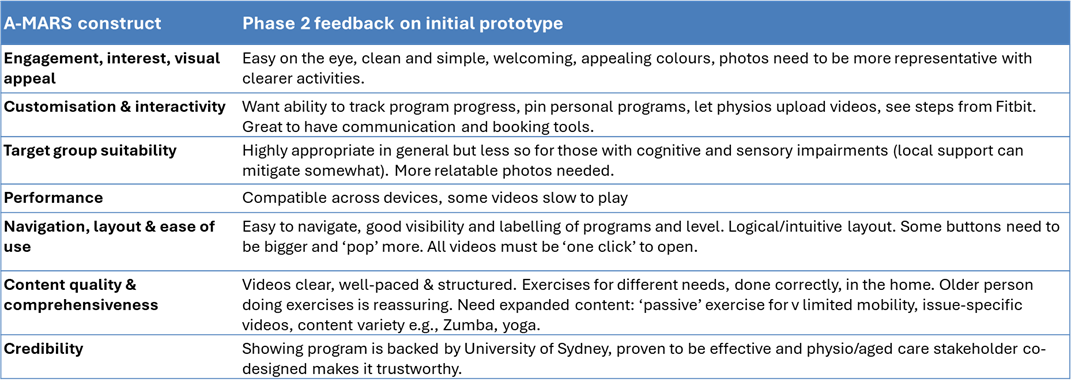
Content analysis identified eight key design themes focusing on simplicity, accessibility, relatability and safety. Users prioritised customisation, minimal staff burden, engaging design, and support to enhance motivation (Figure 1). Critical feedback was captured in the framework analysis in relation to A-MARS constructs (Figure 2). All feedback was addressed iteratively during the new website design. Participants rated the new website positively, reporting improvements in engagement, readability, navigation and credibility.
Figure 1. TOP UP website co-design thematic results
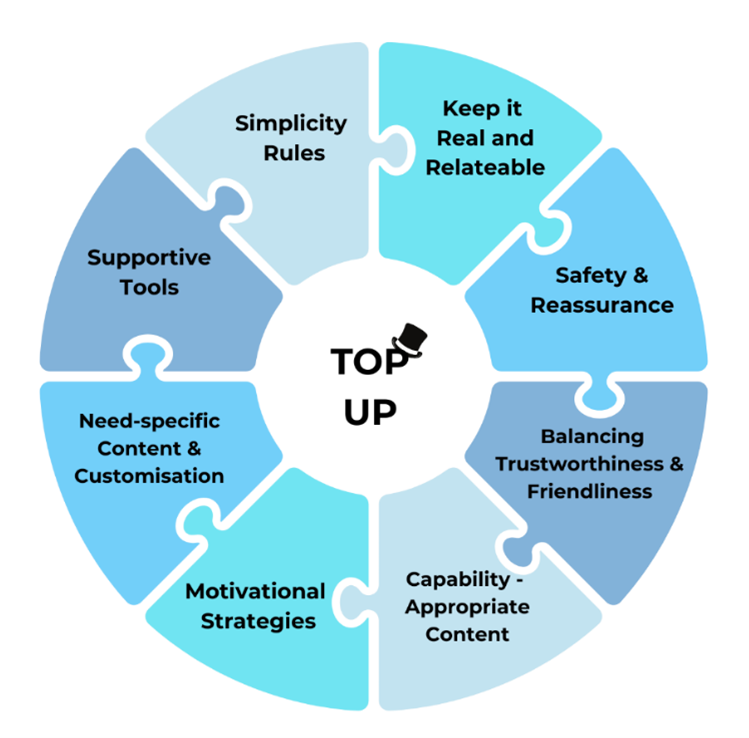
Figure 2. Interim ‘think aloud’ interview feedback in relation to A-MARS scale
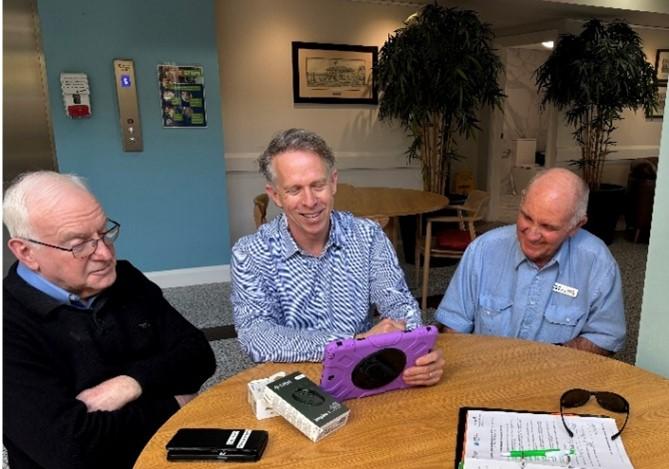
Pictured below: Project Lead, AAG member and President of the Australian Physiotherapy Association (APA), Rik Dawson, testing the TOP UP website with aged care service users on an iPad.
Aged care service users appreciated being treated as partners in the co-design process, as this quote illustrates:
“As an older person you get to think that you’ve been forgotten.… I get a thrill out of being able to do this. It makes me think that you want to know how I think about it all. When you get to my age you just wonder what’s around the corner but now I’m engrossed in this and I’m happy to be doing it.” (Male, assisted living service user, 90 yrs).
Future plans for this work include the commercialisation of a minimal viable product (MVP) adapted from the existing TOP-UP website and telephysiotherapy program. Abby and the team have also secured international funding for a trial of the TOP-UP model in Brazil, which will examine cultural adaptation and feasibility in a new context, with the goal to scale a person-centred, digitally enabled, multidisciplinary approach to restorative care and falls prevention across aged care settings in Australia and beyond.
*Note: Initially, the project focused on co-designing an app, but this changed early on when the team encountered too many compatibility and sustainability issues with using an app, and costs which far exceeded their modest budget.
References
[1] Dawson R, Pinheiro M, Nagathan V, et al. Physiotherapy-led telehealth and exercise intervention to improve mobility in older people receiving aged care services (TOP UP): protocol for a randomised controlled type 1 hybrid effectiveness-implementation trial. BMJ Nutrition, Prevention & Health 2023; 6: 273.
[2] Dawson R, Gilchrist H, Pinheiro M, et al. Experiences of Older Adults, Physiotherapists, and Aged Care Staff in the TOP UP Telephysiotherapy Program: Interview Study of the TOP UP Interventions. JMIR Aging 2024; 7: e53010.
[3] Banbury A, Pedell S, Parkinson L, et al. Using the Double Diamond model to co-design a dementia caregivers telehealth peer support program. Journal of Telemedicine and Telecare 2021; 27: 667-673. DOI: 10.1177/1357633x211048980.
[4] Eccles DW and Arsal G. The think aloud method: what is it and how do I use it? Qualitative Research in Sport, Exercise and Health 2017; 9: 514-531. DOI: 10.1080/2159676X.2017.1331501.
[5] Roberts AE, Davenport TA, Wong T, et al. Evaluating the quality and safety of health-related apps and e-tools: Adapting the Mobile App Rating Scale and developing a quality assurance protocol. Internet Interventions 2021; 24: 100379. DOI: https://doi.org/10.1016/j.invent.2021.100379